• 99%+ purity, third-party tested
  • Malaysia-based supplier, fast local delivery
  • Order online, confirm and pay on WhatsApp
  • For research use only
  • 99%+ purity, third-party tested
  • Malaysia-based supplier, fast local delivery
  • Order online, confirm and pay on WhatsApp
  • For research use only

All products are for laboratory research use only. Not for human consumption.

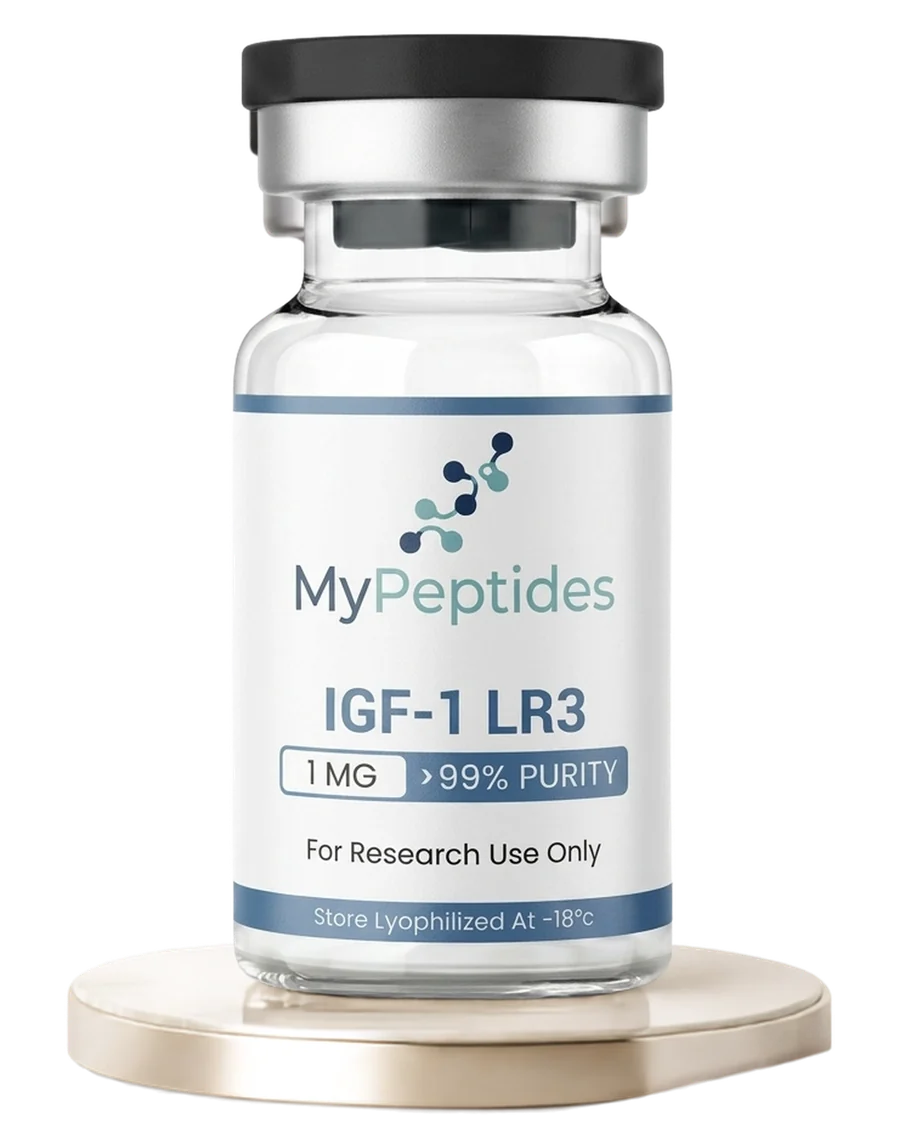
IGF-1 LR3 1 mg vial

Growth Hormone · Anabolic Potentiator

The Long-Acting Growth Factor

IGF-1 LR3

  • 1 mg
  • >99% purity
  • Lyophilised

RM 790

Awaken profound renewal. IGF-1 LR3 1 mg is a master architect, signaling deep cellular regeneration for a visibly firmer, more youthful foundation.

Key mechanisms & benefits

  • By accelerating cellular turnover, it smooths fatigue and restores supple, vibrant energy from the inside out.
  • It optimizes nutrient delivery to maintain lean, elegant muscle and effortless grace.
  • Reclaim your body’s natural building power and move through every chapter with absolute, radiant confidence.
1
Ask about this product

For research use only. Not for human or veterinary consumption. This product is not a medicine and is not intended to diagnose, treat, cure or prevent any disease.

Overview

Modified for Maximum Bioactivity — Extended Half-life IGF-1

IGF-1 LR3 has two key modifications: an arginine substitution at position 3 (instead of glutamic acid) and 13 additional amino acids at the N-terminus. These changes dramatically reduce binding to IGF binding proteins (IGFBP), extending active half-life from 20 minutes to 20-30 hours. The result is virtually all circulating peptide remaining bioavailable — versus just 5% free for native IGF-1.

Mechanism of action

IGF-1 Receptor

Full Receptor Activation

Complete IGF-1R signaling — identical to native IGF-1 at the receptor

  • Full IGF-1R binding affinity — same receptor as native IGF-1
  • Activates PI3K/Akt pathway — cell survival and protein synthesis
  • Activates MAPK/ERK pathway — cell proliferation and differentiation
  • mTOR activation via Akt — primary anabolic protein synthesis driver
  • Activates the mTORC2 complex for cytoskeletal organization
AT VERY LOW IGFBP

IGFBP-Reduced Union

Arg3 substitution eliminates binding protein sequestration

  • Arg3 substitution reduces IGFBP-3 binding 100-1000x
  • IGFBP-1 and IGFBP-2 binding also dramatically reduced
  • Native IGF-1: 95% sequestered by IGFBPs — only 5% free
  • IGF-1 LR3: predominantly free and bioavailable throughout circulation
  • Extended action duration: 20-30 hours vs 20 minutes native
AMPLIFIED

AKT/mTOR Signaling

Protein synthesis, anti-catabolism, and anabolic pathway activation

  • Akt phosphorylation drives protein synthesis initiation
  • mTOR complex 1 activation — ribosomal S6 kinase pathway
  • 4EBP1 phosphorylation — mRNA translation initiation
  • Anti-catabolic: inhibits FoxO-mediated muscle atrophy genes
  • Amplification of anabolic signaling vs native IGF-1

Key finding IGF-1 LR3 retains full pharmacological activity at the IGF-1 receptor while having very low affinity for IGFBPs. This translates to approximately 3 times greater potency and a half-life of 20-30 hours (vs 12-15 hour half-life of regular IGF-1).

Key research findings

2.5x More Powerful

Greater potency versus native IGF-1 in muscle protein synthesis models due to reduced IGFBP binding

Tomas FM et al. J Endocrinol, 1992
>95% Intestinal Weight

Increase in intestinal mass in animal model studies — demonstrates potent anabolic signaling across tissue types

Lemmey AB et al. Am J Physiol, 1997
3+ Protein Saving

IGF-1 LR3 reduces protein catabolism 3-fold versus control in glucocorticoid-treated animal models

Tomas FM et al. Biochem J, 1993
>8g Body Weight

IGF-1 LR3 produced >8g body weight gain over 11 days versus control in animal growth studies

Tomas FM et al. J Endocrinol, 1992

Research areas

Muscle Research

The most potent available form of IGF-1 for muscle protein synthesis and hypertrophy research.

  • Skeletal muscle hypertrophy models
  • Protein synthesis measurement studies
  • Satellite cell activation research
  • Anti-catabolic mechanism studies

Tissue Growth

IGF-1R activation drives growth and repair across multiple tissue types — LR3 provides extended duration of this effect.

  • Bone density research (osteoblast activation)
  • Intestinal mucosa repair research
  • Neural survival and growth factor studies
  • Multi-tissue anabolic research

Neuroprotection

IGF-1 is a critical neurotrophic factor — LR3 extends its neuroprotective action duration significantly.

  • Active research in neurocognitive applications
  • Intranasal administration research models
  • Neuroprotective IGF-1 signaling studies
  • Models of cognitive decline

Catabolic Reversal

Extended half-life makes IGF-1 LR3 uniquely effective in anti-catabolic research — glucocorticoid-induced muscle wasting models.

  • Glucocorticoid-induced catabolic models
  • Muscle wasting disease research
  • Protein conservation studies
  • >8g body weight in 11 days (animal model)

Safety profile

Safety data is limited to preclinical animal studies. There are no human safety data. The following is extrapolated from research with native IGF-1 and observations in animal models.

  • Caution
    Risk of Hypertrophy

    Because IGF-1 LR3 is ~3x more potent than native IGF-1, all potential effects can be amplified — design protocols accordingly

  • Caution
    Risk of Hypoglycemia

    IGF-1 has insulin-like activity — monitor blood glucose in research models

  • Low
    Fluid retention

    IGF-1 promotes sodium and water retention at higher doses

  • Low
    Acromegaly signs

    Excessive IGF-1 can cause acromegalic changes — dose carefully in sensitive models

Animal studies
Generally well tolerated — extensive data
Human data
Not available for IGF-1 LR3
Potency consideration
3x native — design protocols accordingly

Theoretical contraindications in research models

  • Active or history of cancer — IGF-1 signaling promotes cell proliferation
  • Diabetic retinopathy — IGF-1 may promote retinal neovascularization
  • Active acromegaly — additive effect
  • Pregnancy or breastfeeding — insufficient data
  • Banned by WADA (S2 — peptide hormones)

Molecular profile

IGF-1 LR3 Structure

Full name
Long Arg³-IGF-1
CAS number
946870-92-4
Amino acids
83 (13 + 70)
Molecular weight
~9,200 Da
Isoelectric point
~8.9
Molecular formula
C400H625N111O115S9

Structural Modifications

N-terminal extension
13 additional amino acids
Position 3 change
Glutamic acid → Arginine
IGFBP affinity
Dramatically reduced
IGF-1R affinity
Preserved — same as native
Half-life
20-30 hours (vs 20 min native)
WADA status
Banned — S2 category

MYpeptides specification

Strength
1 mg
Purity
> 99%
Form
Lyophilised powder
Storage
Store lyophilised at −18 °C
Status
For research use only

Frequently asked questions

What is the difference between IGF-1 LR3 and native IGF-1?

Native IGF-1 is a 70 amino acid endogenous protein. IGF-1 LR3 adds 13 amino acids at the N-terminus and substitutes arginine for glutamic acid at position 3. These changes reduce IGFBP binding by 100-1000x, extending active half-life from 20 minutes to 20-30 hours. The receptor binding and downstream signaling are identical to native IGF-1.

Why does reduced IGFBP binding make it more potent?

In circulation, 95% of native IGF-1 is sequestered by IGF Binding Proteins (IGFBPs) — only 5% is free and bioavailable at any given time. The LR3 modification reduces IGFBP affinity dramatically, meaning most circulating IGF-1 LR3 is free to bind IGF-1 receptors. This translates to approximately 3x greater effective potency despite identical receptor binding.

Has IGF-1 LR3 been tested in humans?

No human clinical trial data is currently available for IGF-1 LR3 specifically. There is extensive animal study data, and native IGF-1 has been studied in humans. The pharmacology and safety should be extrapolated from native IGF-1 literature, accounting for LR3’s increased potency and extended duration.

What were the main findings in animal studies?

Key animal model findings include: 2.5x greater protein synthesis vs native IGF-1; >8g body weight gain over 11 days vs control; 3x protein conservation in glucocorticoid-induced catabolic models; and significant intestinal growth. These findings establish LR3’s anabolic potency across multiple tissue types.

Is IGF-1 LR3 prohibited in sports?

Yes. IGF-1 LR3 is prohibited by WADA under category S2 (Peptide Hormones, Growth Factors, Related Substances and Mimetics), both in and out of competition. This product is for research use only.

How should IGF-1 LR3 be stored?

Lyophilized IGF-1 LR3 can be stored at 2-8°C or -20°C for up to 24 months. After reconstitution, store at 2-8°C and use within 2-4 weeks. Avoid repeated freeze-thaw cycles. Do not use if the solution appears cloudy or contains particles.

References

  1. IGF variants are anabolic in dexamethasone-treated ratsTomas FM, Knowles SE et al. J Endocrinol, 1992 · PMID: 1630792
  2. Superior potency of IGF-I analogues which bind poorly to IGFBPsTomas FM, Knowles SE et al. Biochem J, 1993 · PMID: 8372755
  3. IGF-I has pleiotropic effects in adipocytes in vitroLemmey AB et al. J Endocrinol, 1999 · PMID: 10534393
  4. IGF-binding protein-binding mechanismsBaxter RC Growth Horm IGF Res, 2000 · PMID: 10985862