• 99%+ purity, third-party tested
  • Malaysia-based supplier, fast local delivery
  • Order online, confirm and pay on WhatsApp
  • For research use only
  • 99%+ purity, third-party tested
  • Malaysia-based supplier, fast local delivery
  • Order online, confirm and pay on WhatsApp
  • For research use only

All products are for laboratory research use only. Not for human consumption.

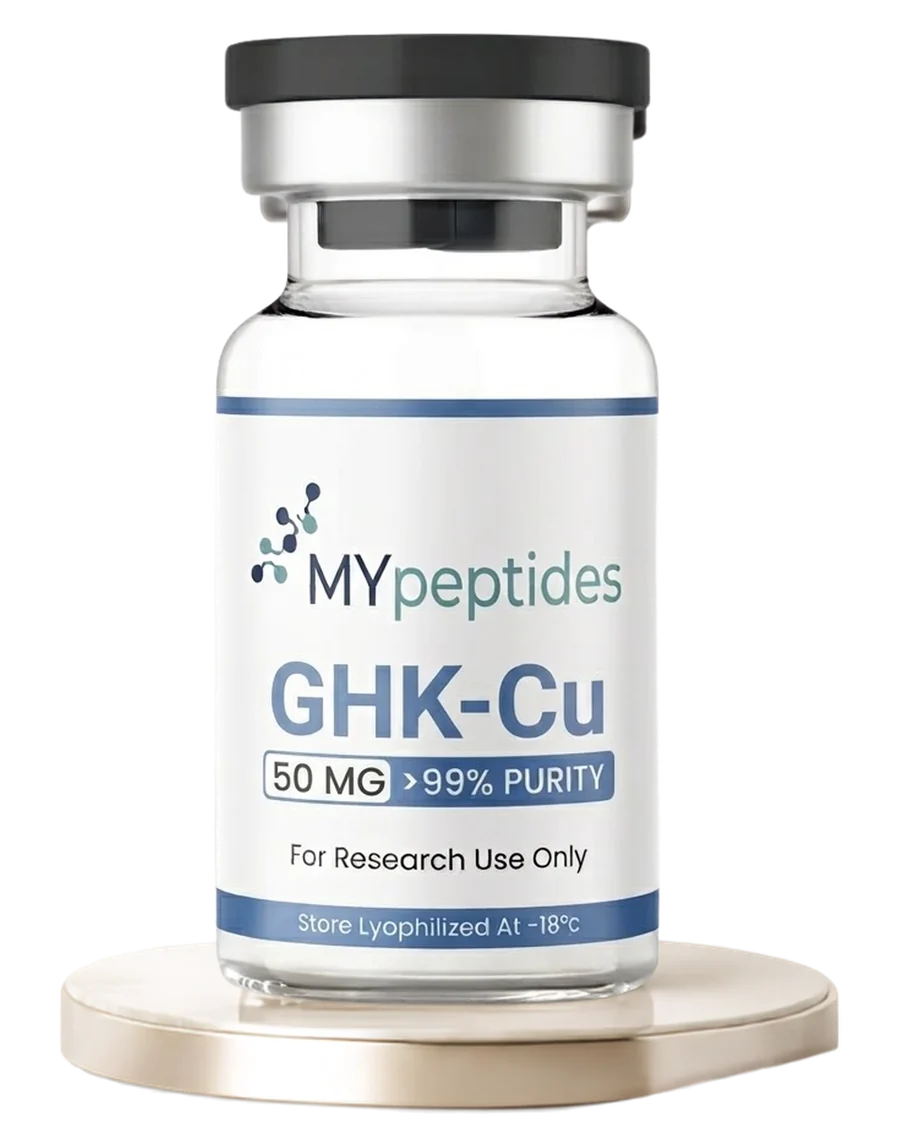
GHK-Cu 50 mg vial

Skin & Aesthetics · Regenerative - Anti-Aging

The Skin & Tissue Remodeler

GHK-Cu

  • 50 mg
  • >99% purity
  • Lyophilised

RM 360

Unlock your sovereign radiance. GHK-Cu 50 mg is the ultimate beauty peptide, resetting your skin’s architecture from the cell up.

Key mechanisms & benefits

  • It powerfully stimulates collagen and elastin, smoothing texture and restoring a naturally lifted, sculpted appearance.
  • By promoting fresh cellular pathways, it delivers vital nutrients to the surface, leaving your complexion brilliantly even and deeply nourished.
  • Reclaim your skin’s resilience, fade visible fatigue, and glow with an effortlessly ageless aura.
1
Ask about this product

For research use only. Not for human or veterinary consumption. This product is not a medicine and is not intended to diagnose, treat, cure or prevent any disease.

Overview

The Master Regulator Copper Tripeptide — 31% of the Human Genome

GHK-Cu modulates the expression of more than 4,000 human genes — approximately 31% of the entire human genome. This extraordinary breadth means a single tripeptide simultaneously upregulates collagen synthesis, DNA repair, antioxidant defense, and anti-inflammatory signaling while downregulating cancer-promoting and inflammatory genes.

Mechanism of action

Genomic Regulation

Master Gene Expression Modulator

4,000+ genes — the broadest genomic reach of any known peptide

  • Upregulates collagen I, III, and IV synthesis genes
  • Activates elastin, fibronectin, and laminin gene expression
  • Downregulates 40+ inflammatory cytokine genes (TNF-a, IL-6, IL-1b)
  • Activates antioxidant defense genes (SOD, catalase, glutathione peroxidase)
  • Modulates 31% of the human genome via SP1 and NF-kB transcription factors
Copper Delivery

Metalloprotein Chaperone Function

Delivers bioavailable copper to critical enzymes requiring it as cofactor

  • Delivers copper to lysyl oxidase — cross-links collagen and elastin
  • Copper delivery to Cu/Zn superoxide dismutase (primary antioxidant enzyme)
  • Supports ceruloplasmin and ferroxidase enzymatic activity
  • Serves as essential cofactor for 30+ copper-dependent enzymes
  • Copper bioavailability enhancement vs free copper ion delivery
DNA Repair and Protection

Nuclear Defense Activation

Activates DNA repair pathways and protects nuclear integrity

  • Upregulates DNA repair genes: p53, BRCA-associated, XPC, XPA
  • Activates base excision repair (BER) pathway
  • Reduces 8-OHdG oxidative DNA damage markers
  • Anti-mutagenic properties in UV-exposed cell cultures
  • Activates DNA damage response independent of copper delivery

Key finding GHK-Cu modulates 31% of the human genome through two transcription factors (SP1 and NF-kB), simultaneously upregulating 2,802 genes and downregulating 1,309 genes — the broadest genomic regulatory reach of any known peptide compound.

Key research findings

-31%

Wrinkle depth reduction versus control in double-blind clinical split-face study at 8 weeks

Pickart L, Margolina A. Cosmetics, 2019
52%

Photodamage reduction versus control in double-blind clinical study using GHK-Cu formulation

Pickart L et al. Cosmetics, 2015
4,000+

Human genes modulated by GHK-Cu in microarray analysis — 2,802 upregulated, 1,309 downregulated

Pickart L, Margolina A. Cosmetics, 2019
Collagen

Significant increase in collagen synthesis in fibroblast cell culture studies at nanomolar concentrations

Maquart FX et al. FEBS Lett, 1988

Research areas

Anti-Aging and Skin Research

The most genomically validated aesthetic peptide — clinical evidence for wrinkle reduction, photodamage repair, and collagen synthesis.

  • Wrinkle depth reduction (-31% clinical)
  • Photodamage repair (52% reduction)
  • Collagen and elastin gene upregulation
  • Skin tightening and density improvement

Genomic and Gene Expression Research

Modulates 31% of the human genome — research implications across oncology, inflammation, aging, and regenerative medicine.

  • SP1 and NF-kB transcription factor research
  • Gene expression modulation studies
  • Anti-cancer gene activation
  • Inflammatory gene suppression

Wound Healing

Accelerates wound repair through simultaneous collagen upregulation, angiogenesis support, and anti-inflammatory gene activation.

  • Collagen synthesis acceleration
  • Wound closure speed
  • Scar reduction vs control
  • Tissue remodeling quality

Antioxidant and DNA Protection

Copper delivery to SOD plus DNA repair pathway activation provides comprehensive oxidative stress protection.

  • ROS neutralization via SOD copper delivery
  • Catalase and glutathione peroxidase upregulation
  • 8-OHdG oxidative DNA damage reduction
  • Nuclear antioxidant defense activation

Safety profile

GHK-Cu has an exceptional safety profile established over 50+ years of research. The primary consideration is copper homeostasis at very high doses, which is not relevant at standard research concentrations.

  • Low
    Copper homeostasis

    At very high non-physiological doses, copper accumulation is theoretical — not relevant at standard research concentrations

  • Low
    Pro-regenerative activity

    Promotes cell proliferation and migration — note in oncology research contexts

  • Low
    Gene expression breadth

    Modulation of 4,000+ genes means off-target effects are theoretically possible — well-characterized in literature

  • Low
    Interaction with metals

    May interact with other metal-chelating compounds or metal-dependent therapeutics

Animal studies
No toxicity findings at research doses
Human data
50+ years — no safety signals
Endogenous status
Natural human plasma peptide

Theoretical contraindications in research models

  • Wilson disease or copper metabolism disorders
  • Concurrent use of copper chelation therapy
  • Active malignancy — pro-proliferative gene upregulation

Molecular profile

GHK-Cu Structure

Full name
Glycyl-L-histidyl-L-lysine copper(II)
Sequence
Gly-His-Lys · Cu²⁺
Molecular weight
340.4 Da
CAS number
49557-75-7
Discovery
Pickart, 1973 — University of Washington
Endogenous
Yes — human plasma peptide

Biological Activity

Genes modulated
4,000+ (31% of genome)
Upregulated
2,802 genes
Downregulated
1,309 genes
Primary TFs
SP1 and NF-kB (regulatory mode)
Collagen effect
Synthesis upregulation
Antioxidant
SOD copper delivery

MYpeptides specification

Strength
50 mg
Purity
> 99%
Form
Lyophilised powder
Storage
Store lyophilised at −18 °C
Status
For research use only

Frequently asked questions

How does one tripeptide modulate 4,000+ genes?

GHK-Cu activates two master transcription factors: SP1 and NF-kB — but in a regulatory, not inflammatory, mode. SP1 alone controls expression of hundreds of genes involved in cell growth, differentiation, and repair. NF-kB in its regulatory form drives anti-inflammatory and protective genes. Additionally, the copper component modulates hypoxia-inducible factors (HIF). The cumulative downstream reach of these cascades is 31% of the human genome.

What is the clinical evidence for wrinkle reduction?

Multiple double-blind split-face clinical studies have demonstrated measurable anti-aging effects: -31% wrinkle depth reduction and 52% photodamage reduction versus control at 8 weeks using GHK-Cu formulations. These are human clinical studies, not just cell culture or animal data.

How does injectable GHK-Cu differ from topical formulations?

Topical GHK-Cu is limited by skin penetration depth — effective for superficial skin layers but cannot deliver systemic concentrations. Injectable research preparations deliver GHK-Cu systemically, enabling it to reach all tissues, organs, and cells throughout the body, accessing the full 4,000+ gene modulation capability.

Why 50mg per vial when most peptides are lower concentration?

GHK-Cu has a large effective dose range for different research applications. The 50mg vial provides flexibility for higher-concentration protocols and extended research duration without frequent re-ordering. It also enables consistent stock for multi-experiment protocols.

Is GHK-Cu truly endogenous?

Yes. GHK-Cu (Glycyl-L-histidyl-L-lysine copper complex) is naturally found in human blood plasma. Concentration is approximately 200ng/mL in young adults, declining to approximately 80ng/mL by age 60. This age-related decline correlates with many signs of skin and tissue aging, making GHK-Cu restoration research particularly relevant.

What distinguishes GHK-Cu from other copper peptides?

GHK-Cu specifically has been the subject of 50+ years of dedicated research by Loren Pickart and others, producing a uniquely deep literature. Other copper peptides exist but lack comparable evidence. The specific Gly-His-Lys sequence creates a copper binding geometry that activates the specific transcription factor cascades documented in peer-reviewed literature.

References

  1. GHK-Cu: A natural regenerative moleculePickart L, Margolina A Cosmetics, 2019 · PMID: 30862020
  2. The human tripeptide GHK-Cu in prevention of oxidative stress and degenerative conditions of agingPickart L et al. Cosmetics, 2015
  3. Stimulation of collagen synthesis in fibroblast cultures by the tripeptide GHKMaquart FX et al. FEBS Lett, 1988 · PMID: 3163991
  4. GHK-Cu: Modulating Genes and Biological PathwaysPickart L, Margolina A Int J Mol Sci, 2018 · PMID: 29772816