• 99%+ purity, third-party tested
  • Malaysia-based supplier, fast local delivery
  • Order online, confirm and pay on WhatsApp
  • For research use only
  • 99%+ purity, third-party tested
  • Malaysia-based supplier, fast local delivery
  • Order online, confirm and pay on WhatsApp
  • For research use only

All products are for laboratory research use only. Not for human consumption.

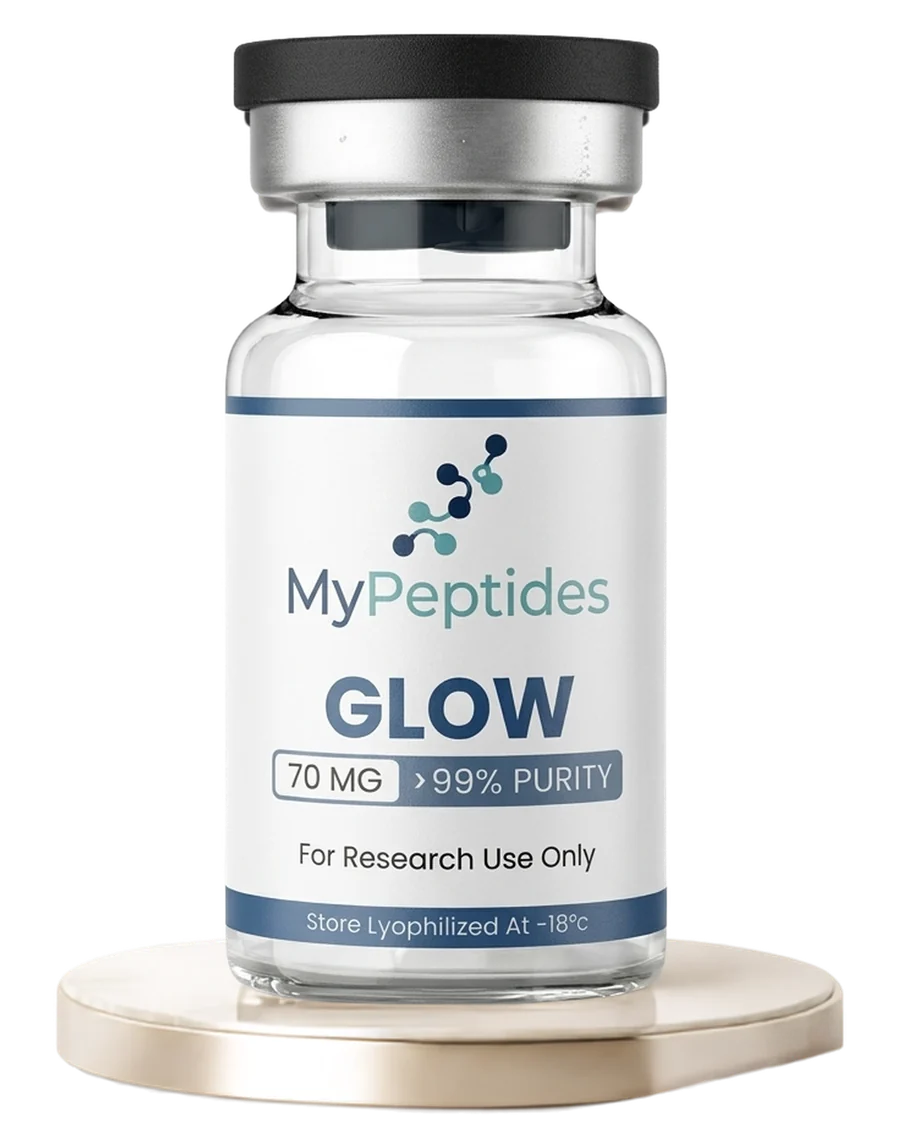
GLOW 70 mg vial

Skin & Aesthetics · Dermal Radiance

The Ultra-Potency Regenerator

GLOW

  • 70 mg
  • >99% purity
  • Lyophilised

RM 500

Reverse the fade. This 70mg master blend is the ultimate cellular reset, restoring your natural radiance from the cell up.

Key mechanisms & benefits

  • It powerfully stimulates collagen and elastin, thickening your skin’s foundation for a visibly lifted, sculpted canvas.
  • By accelerating deep tissue renewal, it smooths texture, fades environmental damage, and delivers a brilliantly even finish.
  • Reclaim your sovereign glow and step into every room with effortless, ageless confidence.
1
Ask about this product

For research use only. Not for human or veterinary consumption. This product is not a medicine and is not intended to diagnose, treat, cure or prevent any disease.

Overview

Triple Regenerative Aesthetic Peptide — Three Simultaneous Biological Levels

GLOW addresses skin aging at three independent levels simultaneously: genomic regulation (GHK-Cu modulates 4,000+ genes including all major collagen and elastin genes), vascular repair (BPC-157 VEGFR2 angiogenesis restores blood supply to aging skin), and structural regeneration (TB-4 G-actin enables cell migration to repair sites).

Mechanism of action

GHK-Cu

Genomic Master Regulation

4,000+ genes — the broadest genomic reach of any known peptide

  • Modulates 31% of the human genome via SP1 and NF-kB
  • Upregulates collagen I, III, IV, elastin, and fibronectin
  • Downregulates 40+ inflammatory cytokine genes
  • Activates DNA repair and antioxidant defense pathways
  • Clinical evidence: -31% wrinkle depth, 52% photodamage reduction
BPC-157

Vascular Repair

VEGFR2 angiogenesis restores blood supply to aging dermal tissue

  • Activates VEGFR2 — primary driver of new vessel formation
  • Growth hormone receptor upregulation at repair sites
  • Restores capillary density in aging and sun-damaged skin
  • FAK-paxillin pathway supports dermal fibroblast migration
  • Systemic anti-inflammatory effect reduces chronic skin inflammation
TB-4

Structural Regeneration

G-actin sequestering enables cell migration to execute repair

  • G-actin binding enables keratinocyte and fibroblast migration
  • ILK/Akt pathway activates stem cells at repair sites
  • Anti-fibrotic effect reduces scarring and improves repair quality
  • Enables cell migration that converts blood supply into tissue repair
  • Synergistic with BPC-157 vascular supply

Key finding GHK-Cu creates the genomic environment for repair (4,000+ genes activated); BPC-157 provides the vascular supply (VEGFR2 angiogenesis); TB-4 executes the cellular migration — all three are prerequisites for each other, making GLOW more than the sum of its parts.

Key research findings

-31%

Wrinkle depth reduction versus control in GHK-Cu split-face clinical study at 8 weeks

Pickart L, Margolina A. Cosmetics, 2019
52%

Photodamage reduction versus control in clinical study with GHK-Cu formulation

Pickart L et al. Cosmetics, 2015
4,000+

Human genes modulated by GHK-Cu in microarray analysis — implications for skin aging

Pickart L, Margolina A. Int J Mol Sci, 2018
VEGFR2

BPC-157 activates VEGFR2 angiogenesis — critical for restoring blood supply to aging skin

Seiwerth S et al. J Physiol Pharmacol, 2018

Research areas

Aesthetic and Skin Research

The most comprehensive skin aging intervention — genomic, vascular, and structural mechanisms addressed simultaneously.

  • Wrinkle reduction and skin texture improvement
  • Photodamage repair research
  • Collagen and elastin restoration
  • Capillary density restoration in aging skin

Genomic Skin Biology

GHK-Cu modulates every major gene involved in skin structure, repair, and defense — research implications beyond topical delivery.

  • Collagen gene expression research
  • DNA repair pathway activation in skin cells
  • Anti-aging gene expression studies
  • NF-kB regulatory mode research

Dermal Vasculature

BPC-157 restores the vascular supply that aging skin progressively loses — prerequisite for all other repair mechanisms.

  • Capillary density restoration
  • Dermal angiogenesis research
  • Blood supply to repair zones
  • GHR upregulation in skin tissue

Cell Migration and Repair

TB-4 enables the cellular migration that converts genomic activation and blood supply into actual structural tissue repair.

  • Keratinocyte migration studies
  • Fibroblast activation research
  • Scar reduction vs control
  • Structural repair quality improvement

Safety profile

All three components have well-established individual safety profiles. GLOW combines them at ratios reflecting their complementary, non-competing mechanisms.

  • Caution
    Pro-angiogenic (BPC-157)

    VEGFR2 angiogenesis — note in oncology research contexts

  • Low
    Pro-proliferative (GHK-Cu)

    Cell proliferation and migration gene upregulation

  • Low
    Immunomodulatory (TB-4)

    TB-4 immunomodulatory activity — note in autoimmune research

  • Low
    WADA status

    All three components are prohibited in competitive sport

GHK-Cu safety
50+ years, no safety signals
BPC-157
No LD50 in toxicology
TB-4
Endogenous peptide, well tolerated

Theoretical contraindications in research models

  • Active or history of cancer — pro-angiogenic and pro-proliferative components
  • Pregnancy or breastfeeding
  • Concurrent oncological treatment
  • WADA-prohibited — all three components banned (S0)

Molecular profile

Component Concentrations

Purity
>99% all components
Format
Sterile lyophilized powder

Molecular Profiles

GHK-Cu MW
340.4 Da
BPC-157 AA
15 amino acids
TB-4 AA
43 amino acids
GHK-Cu CAS
49557-75-7
BPC-157 CAS
137525-51-0
TB-4 CAS
77591-33-4

MYpeptides specification

Strength
70 mg
Composition
GHK-Cu 50 mg + BPC-157 10 mg + TB-500 10 mg
Purity
> 99%
Form
Lyophilised powder
Storage
Store lyophilised at −18 °C
Status
For research use only

Frequently asked questions

How do the three mechanisms complement rather than compete?

GHK-Cu activates the genes needed for repair. BPC-157 provides blood supply via angiogenesis. TB-4 enables the cell migration that executes the repair. Removing any one component creates a bottleneck: without genes activated, cells cannot function; without blood supply, activated cells starve; without migration, repair cells cannot reach the site. All three are prerequisites.

Can these components be used individually for the same effect?

Using each component individually gives its specific mechanism only. GLOW provides simultaneous genomic, vascular, and structural activation that sequential or individual use cannot replicate — particularly because GHK-Cu gene activation occurs alongside (not before) vascular and cellular changes in acute repair scenarios.

What distinguishes GLOW from standard GHK-Cu or BPC-157 alone?

Standard GHK-Cu activates repair genes but lacks enhanced blood supply or cell migration amplification. BPC-157 alone enhances vascular supply but does not fully activate the genomic environment. TB-4 alone enables cell migration but requires both blood supply and genomic activation to be maximally effective. GLOW provides the complete biological environment for skin repair.

References

  1. GHK-Cu: A natural regenerative moleculePickart L, Margolina A Cosmetics, 2019
  2. BPC 157 — gastric and extra-gastric protectionSeiwerth S et al. J Physiol Pharmacol, 2018 · PMID: 30303706
  3. Thymosin beta4: a multi-functional regenerative peptideGoldstein AL et al. Expert Opin Biol Ther, 2012 · PMID: 22074294
  4. GHK-Cu modulating genes and biological pathwaysPickart L, Margolina A Int J Mol Sci, 2018 · PMID: 29772816