• 99%+ purity, third-party tested
  • Malaysia-based supplier, fast local delivery
  • Order online, confirm and pay on WhatsApp
  • For research use only
  • 99%+ purity, third-party tested
  • Malaysia-based supplier, fast local delivery
  • Order online, confirm and pay on WhatsApp
  • For research use only

All products are for laboratory research use only. Not for human consumption.

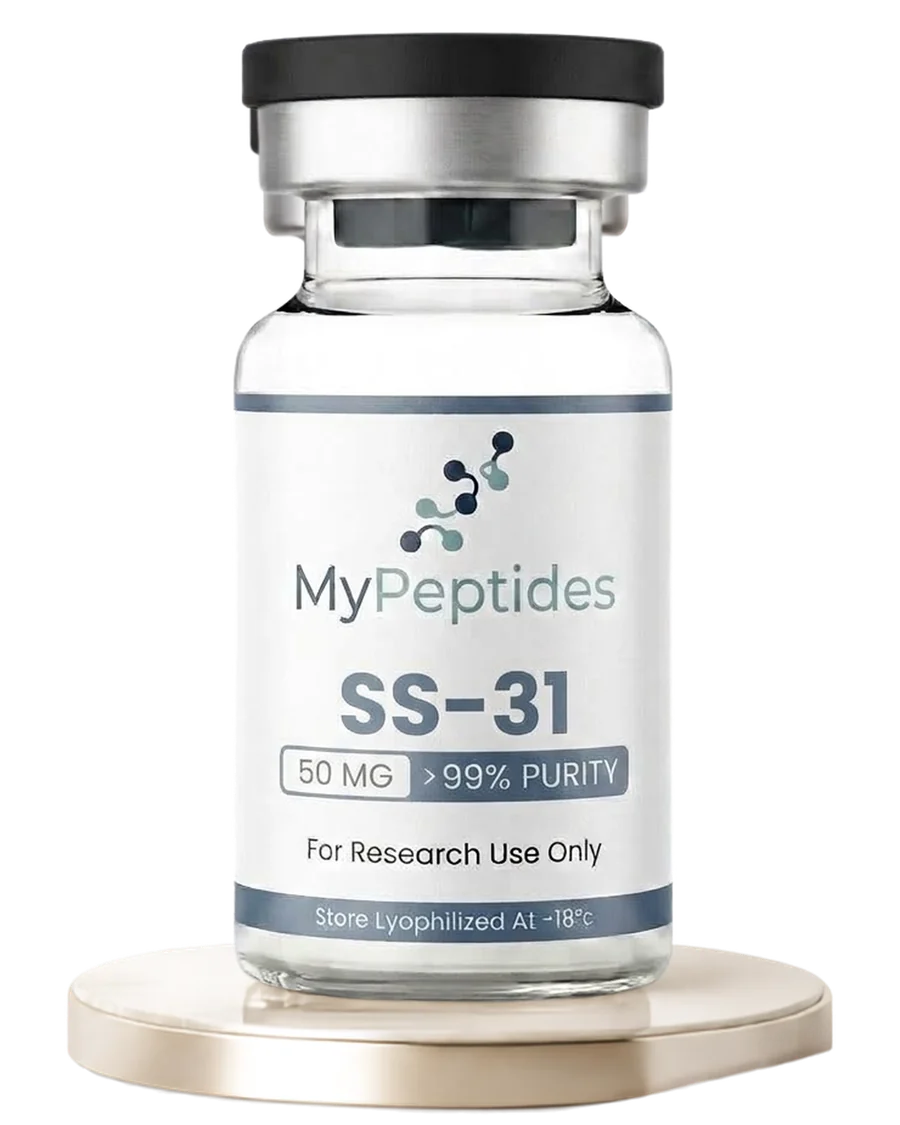
SS-31 50 mg vial

Longevity · Mitochondrial Health

The Cellular Protector

SS-31

  • 50 mg
  • >99% purity
  • Lyophilised

RM 550

Ignite your inner spark. SS-31 50 mg targets the very source of your energy, restoring mitochondrial vitality for effortless, all-day radiance.

Key mechanisms & benefits

  • By reinforcing your cells' inner architecture, it optimizes natural power production to keep you vibrant and resilient.
  • It neutralizes oxidative stress and cellular fatigue, protecting your tissues from the invisible signs of aging.
  • Reclaim your body’s youthful baseline and move through every chapter with absolute, ageless strength.
1
Ask about this product

For research use only. Not for human or veterinary consumption. This product is not a medicine and is not intended to diagnose, treat, cure or prevent any disease.

Overview

The Most Mitochondria-Targeted Peptide — 1,000x IMM Concentration

SS-31 (Elamipretide) concentrates 1,000x more in the inner mitochondrial membrane than in the cytoplasm through passive electrostatic interaction with cardiolipin — the phospholipid uniquely enriched in the IMM. Once there, it stabilizes cristae architecture, neutralizes mitochondrial ROS at the source, and restores ATP production efficiency. Phase 2 data: 40% improvement in 6-minute walk test in heart failure patients.

Mechanism of action

Cardiolipin Binding

Passive IMM Targeting

Electrostatic concentration in the inner mitochondrial membrane

  • Alternating aromatic/cationic residues bind cardiolipin electrostatically
  • Cardiolipin is exclusively concentrated in the IMM — explains selective targeting
  • 1,000x concentration ratio: IMM vs cytoplasm (passive, no active transport)
  • Therapeutic concentrations reached rapidly and maintained without energy cost
  • The only peptide known to achieve this level of IMM-selective concentration
ROS Neutralization

Mitochondrial Antioxidant at Source

Reactive oxygen species neutralized at the point of generation

  • D-Arg residues donate electrons to neutralize mitochondrial superoxide directly
  • ROS neutralized at the ETC — before they can escape to damage cytoplasm
  • Reduces mtDNA oxidative damage — preserves mitochondrial genome integrity
  • Decreases lipid peroxidation in the IMM — protects membrane architecture
  • Prevents cardiolipin oxidation — the initiating event in mitochondrial dysfunction
Cristae Architecture

ETC Optimization and ATP Recovery

Stabilizes mitochondrial cristae for efficient electron transport

  • Stabilizes cardiolipin-cytochrome c interaction at cristae junctions
  • Preserves cristae folding geometry for optimal ETC complex proximity
  • Restores ATP synthase efficiency — higher ATP/O ratio
  • Prevents cristae junction widening that occurs in aging and heart failure
  • Recovers mitochondrial membrane potential (ΔΨm)

Key finding SS-31 concentrates 1,000x in the inner mitochondrial membrane via passive cardiolipin interaction — no active transport required. This extraordinary selectivity allows it to neutralize mitochondrial ROS at their source and restore cristae architecture, reversing the primary mechanism of mitochondrial dysfunction in aging and disease.

Key research findings

40%

Improvement in 6-minute walk test distance in Phase 2 HFpEF trial at 4 weeks versus placebo

Daubert MA et al. Eur J Heart Fail, 2020
1,000x

Concentration ratio in IMM versus cytoplasm — documented by fluorescent labeling and fractionation studies

Szeto HH. Pharm Res, 2011
Cardiolipin

Exclusive cardiolipin-binding specificity — explains IMM selectivity without active transport

Birk AV et al. J Am Soc Nephrol, 2013
Phase 2

MMAD trial: significant improvement in exercise capacity in HFpEF patients at 4 weeks

Kates AM et al. Circ Heart Fail, 2020

Research areas

Heart Failure Research

The most validated mitochondrial therapeutic for heart failure — Phase 2 human data showing functional improvement.

  • HFpEF and HFrEF research
  • Cardiac energetics studies
  • Exercise capacity research
  • Cardiac mitochondrial dysfunction models

Mitochondrial Biology

The gold standard research tool for IMM-specific intervention — 1,000x selectivity enables precise mitochondrial studies.

  • IMM-specific intervention studies
  • Cardiolipin biology research
  • ETC complex activity studies
  • Mitochondrial membrane potential research

Aging and Longevity

Mitochondrial dysfunction — driven by cardiolipin oxidation and ETC decline — is a primary aging mechanism.

  • Mitochondrial aging research
  • Cristae architecture studies
  • Lifespan extension models
  • Age-related ETC decline

Ischemia-Reperfusion

SS-31 preconditioning protects against ischemia-reperfusion injury across cardiac, renal, and neural tissue.

  • Cardiac I/R injury models
  • Renal ischemia research
  • Neural I/R protection
  • Organ transplant research

Safety profile

SS-31 (Elamipretide) has completed Phase 2 human trials with a favorable safety profile. It is the most clinically validated mitochondria-targeted peptide.

  • Low
    Injection site reactions

    Mild local reactions at injection site — consistent with Phase 2 data

  • Low
    Blood pressure

    No significant blood pressure effects documented in Phase 2

  • Low
    Hypersensitivity

    Low frequency hypersensitivity reactions reported in Phase 2

  • Low
    Drug interactions

    Potential interaction with other mitochondria-targeting compounds

Animal studies
Extensive — multiple species and models
Human data
Phase 2 completed HFpEF
Tolerability
Well tolerated in Phase 2

Theoretical contraindications in research models

  • Known cardiolipin metabolism disorders (rare)
  • Concurrent mitochondria-targeting therapies
  • Severe hepatic impairment — insufficient data

Molecular profile

SS-31 Structure

Generic name
Elamipretide / MTP-131
Sequence
D-Arg-Dmt-Lys-Phe-NH2
Amino acids
4
Molecular weight
639.8 Da
CAS number
736992-21-5
Modification
D-amino acid, Dmt residue

Targeting Mechanism

Target
Cardiolipin — IMM exclusive
Concentration ratio
1,000x IMM vs cytoplasm
Mechanism
Passive electrostatic interaction
Active transport
None required
IMM half-life
Extended — cardiolipin anchored
Antioxidant residue
D-Arg, Dmt — electron donation

MYpeptides specification

Strength
50 mg
Purity
> 99%
Form
Lyophilised powder
Storage
Store lyophilised at −18 °C
Status
For research use only

Frequently asked questions

How does SS-31 achieve 1,000x concentration in the IMM without active transport?

SS-31’s peptide sequence contains alternating aromatic (Dmt, Phe) and cationic (D-Arg, Lys) residues. This creates an electrostatic charge pattern that interacts with the negative phosphate head groups of cardiolipin — a phospholipid uniquely concentrated in the inner mitochondrial membrane. This passive electrostatic interaction requires no energy expenditure and concentrates SS-31 precisely where it is needed.

What is cardiolipin and why is it the key to SS-31’s mechanism?

Cardiolipin is a unique phospholipid with four fatty acid chains that is almost exclusively found in the inner mitochondrial membrane. It is essential for organizing the electron transport chain complexes into supercomplexes, maintaining cristae architecture, and supporting cytochrome c binding. Oxidation of cardiolipin — which occurs during mitochondrial stress — disrupts all of these functions. SS-31 binds cardiolipin, protects it from oxidation, and restores its functional interactions.

What was the Phase 2 trial and what did it find?

The MMAD trial (NCT02142673) studied Elamipretide (SS-31) in patients with heart failure with preserved ejection fraction (HFpEF) — a difficult-to-treat form of heart failure where the heart pumps normally but is stiff. At 4 weeks, SS-31 improved the 6-minute walk test distance by approximately 40% versus placebo — a clinically meaningful functional improvement in this patient population.

How does cristae architecture affect heart function?

Mitochondrial cristae are the inner membrane folds where the electron transport chain complexes (I-V) reside. Their organization into supercomplexes on these cristae folds determines the efficiency of electron transfer and ATP production. In heart failure, cristae become disorganized — reducing ATP production efficiency precisely when the heart needs more energy. SS-31 restores cristae architecture, recovering ATP production.

Is SS-31 still in clinical development?

Yes. Following Phase 2, Stealth BioTherapeutics and later Epirium Bio continued development. Phase 3 clinical programs have been initiated or are in planning for heart failure and Barth syndrome (a rare genetic cardiolipin disorder). The compound has Orphan Drug designation for Barth syndrome.

References

  1. Elamipretide in heart failure with preserved ejection fractionDaubert MA et al. Eur J Heart Fail, 2020 · PMID: 32020701
  2. SS-31 targets inner mitochondrial membrane cardiolipinBirk AV et al. J Am Soc Nephrol, 2013 · PMID: 23908457
  3. The cardioprotective peptide SS-31 reverses mitochondrial injurySzeto HH Pharm Res, 2011 · PMID: 21360283
  4. SS-31 restores mitochondrial function and improves exercise capacity in heart failureKates AM et al. Circ Heart Fail, 2020
Longevity

The Cellular Powerhouse

NAD+

1000 mg · >99% purity

RM 460